

Middle Tennessee's Spring Storm Season Is a Business Continuity Event
Commercial property owners and managers in Murfreesboro, Franklin, and Brentwood operate in one of the country's more active severe weather corridors, and the spring storm season that Middle Tennessee experiences is not a peripheral business concern that occasional bad weather creates. It is a defining seasonal business risk whose character reflects the atmospheric dynamics that produce the organized storm systems, tornadoes, significant hail events, and concentrated rainfall totals that Tennessee's position within the Gulf moisture corridor creates when spring's temperature contrasts drive the convective activity that the region's spring storm season is known for nationally.
The commercial property environment across this service area reflects the region's diverse development character. Murfreesboro's commercial landscape spans the established downtown corridors and the rapidly developing retail and commercial nodes that the city's growth has been creating along its major arterials. Franklin's commercial environment includes the historic downtown district whose properties carry the specific vulnerability profile of older construction alongside the premium commercial development that Williamson County's affluence has produced along its major commercial corridors. Brentwood's commercial character reflects the established, premium-positioned businesses and professional services that the community's residential character supports.
The common thread across these diverse commercial environments is the Middle Tennessee spring storm season whose organized storm systems test every commercial building in the service area with the hail, wind loading, concentrated rainfall, and the tornado risk that the region's severe weather culture acknowledges as a genuine operational reality rather than a background statistical concern. The commercial property that enters that season with unassessed roofing conditions, compromised building envelope sealing, and drainage systems carrying winter's accumulated debris is not positioned to manage the season as a planned maintenance situation. It is positioned to discover through storm damage what pre-season assessment would have identified at the cost of correction rather than the cost of emergency repair plus business interruption.
What Middle Tennessee's Winter Produces in Commercial Building Systems

Roofing conditions after Middle Tennessee's winter reflect the thermal cycling that the region's occasional hard freeze events and the temperature variation between winter cold snaps and the warming periods between them delivers to commercial roofing membranes, flashings, and the drainage systems that manage roof water through the spring storm season's concentrated rainfall events. The specific thermal cycling mechanism that Middle Tennessee's winter creates in commercial roofing differs from the sustained cold that northern climates produce, operating through repeated freeze-thaw events that each contribute incrementally to the membrane seam stress, flashing adhesion failure, and drainage component conditions that spring assessment identifies before the storm season's rainfall tests whatever those conditions currently are.
Single-ply membrane roofing on commercial buildings throughout Murfreesboro's and Franklin's commercial corridors experiences the thermal cycling that Middle Tennessee's winter delivers to membrane seam interfaces and penetration flashings in ways that the region's occasional hard freeze events specifically advance. HVAC curb flashings, pipe penetration seals, and parapet wall cap conditions all reflect what the previous heating season's thermal cycling contributed to the cumulative condition that spring assessment evaluates before the first organized spring storm provides its own condition test.
Building envelope sealant conditions on commercial properties across the service area reflect the freeze-thaw cycling that Middle Tennessee's winter produces in the caulked joints and transitions of commercial building envelopes. Commercial building facades in Murfreesboro's established downtown, Franklin's historic district, and the commercial corridors of both communities carry the sealant systems at window perimeters, expansion joints, and utility penetrations that Middle Tennessee's thermal cycling advances toward adhesion failure at rates that the region's occasional freeze-thaw events create rather than the sustained cold that more northern commercial markets manage through longer winter seasons.
Drainage system conditions on commercial rooftops and site surfaces carry the debris accumulation and biological growth that Middle Tennessee's warm fall conditions initiated before winter and that winter's precipitation then advanced in drainage components that receive limited maintenance attention between the outdoor seasons that flank the heating period. A commercial roof drain partially blocked by organic debris and biological accumulation in a Murfreesboro or Franklin commercial building enters the spring storm season with reduced drainage capacity that the first significant storm event tests against whatever blockage currently exists in that drain body.
The Tornado Risk Dimension of Middle Tennessee Commercial Property Preparation
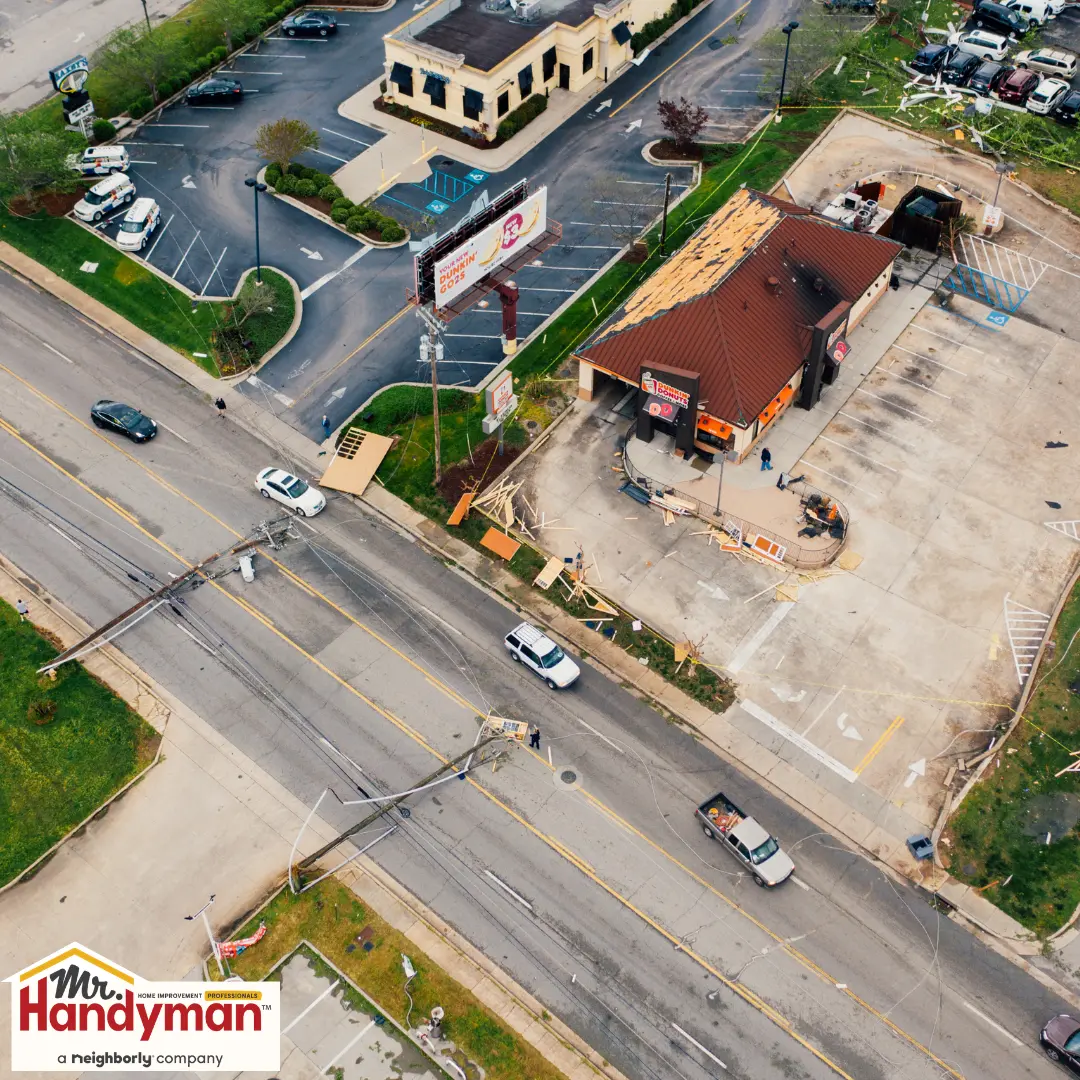
Tornado preparedness adds a dimension to Middle Tennessee commercial property spring storm preparation that moderate-climate commercial markets do not include with the same frequency or consequence. Middle Tennessee's position within the region that Tennessee Emergency Management designates as among the state's higher tornado risk corridors creates the specific severe weather culture that Murfreesboro, Franklin, and Brentwood businesses manage as an operational reality.
Commercial property preparation for tornado risk includes both the physical building condition assessment that pre-storm season maintenance addresses and the emergency management planning that tornado warnings during business operating hours require. Identifying the most structurally protected interior spaces in commercial buildings for employee and customer shelter, confirming those spaces are accessible and unobstructed, and establishing the communication protocols that alert building occupants when tornado warnings are issued for the service area represent the operational preparation that complements the physical building maintenance that pre-storm season assessment addresses.
Roof-to-wall connections and parapet conditions on Middle Tennessee commercial buildings deserve the specific assessment that tornado wind loading creates as a structural concern beyond what straight-line wind events and concentrated rainfall produce. The uplift forces that tornado wind loading applies to commercial roofing systems are qualitatively different from the lateral loading that organized frontal system winds create, and commercial buildings in Middle Tennessee's active tornado corridor warrant the structural assessment that specifically evaluates roof-to-wall connection integrity as a pre-storm season maintenance item.
Building Envelope Preparation for Middle Tennessee's Storm Season

The building envelope conditions of commercial properties in Murfreesboro, Franklin, and Brentwood carry what Middle Tennessee's winter freeze-thaw cycling and biological growth produced in the caulked joints, facade surfaces, and window and door assemblies that spring storms will test through concentrated wind-driven rainfall events before the warm season's stable conditions arrive.
Caulking and sealant restoration at every building envelope transition on Middle Tennessee commercial properties addresses the joint conditions that winter's thermal cycling compromised and that spring's organized storm systems will test with horizontal wind-driven rain that penetrates joints adequate for vertical rainfall but insufficient for the lateral pressure that significant Middle Tennessee storm winds apply to facade joints. Commercial buildings in Murfreesboro's developing commercial corridors and Franklin's established retail environments carry the caulked transitions at window perimeters, curtain wall joints, and utility penetrations that each winter's contribution to cumulative sealant adhesion failure advances toward the infiltration threshold that spring assessment identifies before spring storms test it.
Elastomeric sealant products whose flexibility encompasses Middle Tennessee's full seasonal temperature range perform better through the region's thermal cycling than standard caulk formulations whose flexibility assumes moderate thermal variation. Spring sealant replacement at identified failure locations with products appropriate for Middle Tennessee's conditions produces the weather exclusion that spring storm wind-driven rain tests at every joint the organized systems encounter.
Masonry condition on commercial buildings throughout the service area reflects the freeze-thaw mechanism that Middle Tennessee's winter delivers to brick and block facade assemblies through the repeated cycling that the region's transitional climate produces more frequently than sustained cold northern climates. Commercial properties in Franklin's historic district carry the older masonry construction whose mortar joint conditions reflect decades of Middle Tennessee's seasonal cycling, and spring mortar joint assessment before the storm season delivers the rainfall that open mortar joints direct into the wall assembly behind the masonry veneer provides the repair window that addressing rather than covering deteriorated mortar joints requires.
Loading dock and service entry conditions at commercial properties throughout Murfreesboro and Franklin carry the weatherstripping failures, door seal deterioration, and concrete apron conditions that Middle Tennessee's seasonal thermal cycling and the commercial traffic those entries manage creates between maintenance intervals. Dock seal condition, door bottom sweeps, and the threshold seals at commercial service entries all warrant the spring assessment that confirms their function before the business season's increased traffic and Middle Tennessee's spring rainfall events test the weather exclusion that those components are designed to provide.
HVAC and Mechanical Systems: Storm Season Readiness
Rooftop HVAC equipment attachment deserves specific spring attention for Middle Tennessee commercial properties because the thermal cycling that winter delivers to rooftop equipment mounting hardware, combined with the tornado risk that the region's severe weather season creates for uplift loading on rooftop equipment, produces the mounting hardware condition concerns that pre-season assessment addresses before spring's organized storm systems test those connections under actual wind loading conditions.
The HVAC seasonal transition from heating to cooling mode in Middle Tennessee commercial buildings involves the compressed shoulder season that the region's spring delivers between winter's heating demands and the summer cooling that the Tennessee Valley's warm season requires relatively early in the calendar year. Commercial HVAC systems transitioning to cooling mode before spring storm season's peak activity should have the coil condition, drain pan status, and refrigerant system performance that heating season operation produced confirmed through spring service before full cooling demand and the storm season's peak arrive simultaneously.
Emergency generator readiness for Middle Tennessee commercial properties whose operations cannot tolerate the power outages that significant storm events create in the service area should be confirmed through load testing, fuel supply verification, and automatic transfer switch function assessment before the spring storm season rather than during the power outage event that reveals inadequate preparation. Middle Tennessee's spring tornado and severe thunderstorm events produce the power outages that commercial operations dependent on continuous power cannot absorb without the confirmed backup that generator readiness provides.
Site and Exterior Infrastructure Assessment
Parking area drainage at commercial properties throughout the service area carries the crack advancement, surface deterioration, and inlet blockage conditions that Middle Tennessee's winter and early spring produce in commercial paving and drainage infrastructure. The concentrated rainfall that Middle Tennessee's organized spring storm systems deliver to commercial parking areas tests drainage systems within hours of system arrival, and the inlet blockages and crack conditions that pre-season assessment identifies and addresses before those tests occur convert reactive emergency drainage management into planned maintenance.
Exterior signage structural condition assessment before Middle Tennessee's storm season evaluates the mounting hardware, structural connections, and sign cabinet conditions that wind loading from organized storm systems will test. Middle Tennessee's tornadic severe weather activity creates the wind loading on commercial signage that exceeds what straight-line winds alone produce in less severe weather markets, and pre-season mounting hardware inspection and torque verification at commercial signage supports the confidence that those connections will manage the spring storm season's wind events without the displacement or failure that inadequate hardware assessment leaves undetected until storm conditions test them.
Tree and landscape hazard management at commercial properties in Murfreesboro, Franklin, and Brentwood addresses the storm damage risk that the mature trees in the service area's established commercial landscapes create for buildings, vehicles, and the customers and employees occupying those properties during Middle Tennessee's spring storm events. Trees with significant dead limb content, root systems that Middle Tennessee's clay soil dynamics have compromised, or crown profiles that create asymmetric wind loading risk warrant the professional arborist assessment and pre-season hazard management that spring provides the access and timing for before summer's full leaf canopy makes wind loading assessment more complex.
Frequently Asked Questions
How should Middle Tennessee commercial properties document storm damage for insurance claims?
Dated photographic documentation of pre-storm condition established through the spring assessment program provides the comparison baseline that storm damage claims require to distinguish storm-caused damage from pre-existing conditions. Commercial property owners in Murfreesboro, Franklin, and Brentwood should maintain dated inspection reports with photographs from each pre-season assessment, retain contractor invoices documenting completed repairs with scope descriptions and completion dates, and file storm damage claims within the reporting timelines that Tennessee commercial property insurance policies specify. Middle Tennessee's active spring storm season creates the claim frequency that organized documentation practices specifically support in the insurance claim process.
What storm damage is most common in Middle Tennessee commercial properties during spring?
Roofing membrane and flashing failures that Middle Tennessee's freeze-thaw cycling advanced toward the infiltration threshold, combined with the concentrated rainfall and wind loading that organized spring storm systems deliver to commercial roofing assemblies, are the most consistently identified spring storm damage findings across the service area. Hail damage to roofing surfaces, HVAC equipment on commercial rooftops, and exterior glazing represents the physical impact damage category that Middle Tennessee's active severe weather season delivers with the frequency that distinguishes this market from moderate-weather commercial environments. Signage displacement from wind loading and parking area drainage failures from drain inlet blockage represent the site condition categories that storm events most commonly advance from developing maintenance conditions to visible damage.
How does tornado risk specifically affect commercial property preparation priorities in Middle Tennessee?
Tornado risk adds the structural integrity assessment dimension to Middle Tennessee commercial property preparation that roof-to-wall connection evaluation, parapet wall condition, and emergency shelter designation specifically address. Commercial buildings in the service area should confirm that roof attachment hardware meets the uplift resistance requirements that Tennessee's building code establishes for the region's wind exposure category, that parapet walls carry the structural integrity to resist the lateral and uplift loading that tornado wind fields create, and that the emergency shelter spaces designated for occupant protection are confirmed unobstructed and accessible before the spring storm season activates the warning situations that require those spaces to serve their protective function.
Is commercial property storm damage covered by standard business insurance in Tennessee?
Standard commercial property insurance policies in Tennessee typically cover wind, hail, and storm damage as named perils, though policy-specific language, deductibles, and coverage limits vary significantly. Tennessee commercial property owners should review their specific policy wind and hail deductible structures before the storm season, because Middle Tennessee's active severe weather record has driven some commercial policies to percentage-of-value deductibles for wind and hail claims that fixed dollar deductibles do not reflect. Reviewing coverage adequacy with a qualified Tennessee insurance professional before the storm season provides the clarity that claim situations benefit from having been established in advance.
How far in advance of the active spring storm season should Middle Tennessee commercial properties complete storm preparation?
March assessment and repair completion before April's increasing storm activity provides the appropriate timing buffer for Middle Tennessee commercial property spring storm preparation. The organized storm systems that Middle Tennessee's spring delivers begin increasing in frequency and severity through April and peak through May, and the preparation that completes through March provides the full month of buffer that construction availability and material lead times for identified repairs require. Commercial properties that delay storm preparation assessment into April risk discovering conditions whose repair cannot be completed before the most active storm period tests them.
Prepared Commercial Properties Navigate Middle Tennessee's Storm Season From Strength
The commercial properties in Murfreesboro, Franklin, and Brentwood whose owners and managers complete systematic spring storm preparation before the severe weather season's most active months are positioned to manage the region's organized storm systems, tornado events, and concentrated rainfall as planned maintenance situations rather than emergency discoveries. The roofing conditions, building envelope vulnerabilities, drainage inadequacies, and structural concerns that pre-season assessment identifies and addresses represent costs managed on planned timelines rather than the emergency service rates and business interruption consequences that the same conditions discovered through storm damage create.
The team at Mr. Handyman of Murfreesboro, Franklin, and Brentwood brings the commercial property maintenance experience to help business owners and property managers prepare their Middle Tennessee properties comprehensively before spring storm conditions test everything those buildings are carrying into the season.
Website: https://www.mrhandyman.com/murfreesboro-smyrna/
Serving businesses throughout Murfreesboro, Franklin, and Brentwood with dependable commercial maintenance and the expertise your property deserves.